
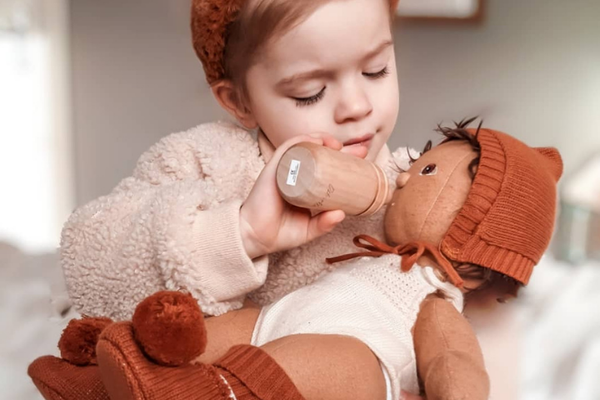
There’s something quite powerful about the way children care for dolls.
A simple moment of feeding, cuddling or tucking in becomes a full story in motion, one filled with kindness, imagination and emotion. What looks like play on the surface is often a child making sense of the world in their own gentle way.
Through these small, everyday moments, doll play becomes a trusted part of growing up.
Learning kindness through care
When a child picks up a doll, they naturally begin to care for it.
It might be hungry, tired, or in need of a comforting cuddle. The child responds instinctively, deciding how to help and what their companion needs next.
In doing so, they’re exploring empathy in a very natural way, not as something taught, but something experienced through play. They begin to understand feelings from another point of view, one gentle moment at a time.
Finding their voice through storytelling

Doll play often becomes a running conversation.
Children talk to their dolls, answer on their behalf, and create entire exchanges between characters. In doing so, they’re building language in the most organic way possible, through imagination and repetition.
Along the way, they’re trying out new words, shaping sentences, and weaving stories that help them make sense of everyday life. What begins as simple play often becomes a rich world of storytelling and communication.
Making sense of big feelings
Sometimes dolls become part of moments that feel a little bigger than words.
A visit to the doctor might be replayed with a poorly teddy. A first day at school might be acted out at home, with the doll taking the lead role. Through these stories, children can explore what’s ahead or reflect on what has already happened, all in a space that feels safe and familiar.
Doll play gives children room to return to these moments as often as they need, helping big feelings feel a little more manageable over time.
Growing confidence through care
Looking after a doll gives children something meaningful to hold.
They become the one in charge - the caregiver, the storyteller, the decision-maker in every little scenario. Whether it’s choosing what their doll wears or where they go next, each choice helps build a sense of independence.
These small acts of care and responsibility quietly build confidence, one play session at a time.
A companion for every child

Dolls aren’t just for one kind of child.
They offer comfort, connection and companionship in different ways for everyone who plays with them. Some children use them for storytelling, others for reassurance, and many for both at once.
What matters most is the relationship that grows between child and companion, something entirely personal, shaped by imagination and care.
Where every story begins
Every friend in Dinkum World arrives with their own name, personality and little story, ready to become part of yours.
From everyday routines to full-scale adventures, they’re there for every cuddle, every conversation and every make-believe moment along the way.
Touch the rainbow over your Dinkum's heart, close your eyes and see where your next story begins.
Meet your new little companion and discover a world of play.


